Yes, very much so. As an alcohol- and rosin-free gel with a choice of flavours, Profisil® Fluoride Varnish is suitable for all age groups, especially children.
In general, cleaning with fluoride toothpaste does enhance overall fluoride supply. Long-term protection arises from the combination of professional lacquer (deposit effect) and daily toothpaste (continuous supply). The effect adds up: The fluoride from the varnish creates a depot through repeated professional application (e.g., every 3-6 months), while the toothpaste regularly provides new fluoride.
Do not use other products containing fluoride within 24 hours of using the varnish.
The unique mixture of dimethicones in Profisil® Fluoride Varnish allows for a solvent-free and substantive material that has excellent properties of muco-adhesion as well as hard tissue adhesion. The solvent-free formula of Profisil® offers improved biocompatibility, and easier handling, while maintaining effective fluoride delivery.
Unlike varnishes that contain solvent, Profisil® offers unlimited working time during application and is very easy to manipulate into the areas between teeth. Since there is no solvent, there is no risk of clumping from fast solvent evaporation.
Profisil® can be applied to both teeth and soft tissue without the burning sensation from solvent flashing. Patients appreciate the non-stick feel and the silky-smooth tooth surface, along with a refreshing sensation in the mouth. It is well suited for patients of all ages, including children.
Profisil® can be applied equally well to moist or dry teeth and tissue. Drying the tissue or teeth may increase adhesion and substantivity.
A prophylactic cleaning is not required before use, but is recommended for maximum effectiveness. If a cleaning is performed, apply the varnish following scaling and polishing.
No, Profisil® does not contain gluten, peanuts, tree nuts, soy, sesame, corn, shellfish, egg or dairy products. The varnish is free of dyes, color pigments and optical brighteners.
Mint and Unflavored is not made with ethyl alcohol, Berry may contain traces of ethyl alcohol. Allergic reactions to the product cannot be ruled out in sensitive persons. Potential allergenic substances include natural and artificial berry flavor. Do not use this product on any individual who has a known intolerance to fluoride.
Fluoride varnish can be useful for children with enamel hypoplasia, though it does not address the absence of enamel itself. Profisil® Fluoride Varnish forms a durable protective layer with rapid desensitization and creates a long-term reservoir of calcium and fluoride, providing protection for weeks to months, especially with repeated applications. Fluoride supports remineralization of the tooth surface, strengthening the teeth even in the presence of hypoplasia. While it cannot recreate missing enamel, it can alleviate symptoms and help prevent further damage.
For children with more severe hypoplasia, additional treatments are often needed, such as restorations with composite fillings or even crowns, depending on the severity. A dentist can recommend the best treatment options based on the individual situation.
Both the dental team and the patient confirm the ease of use and positive results after treatment with Profisil®. Patients appreciate the non-stick feel and the silky-smooth tooth surface, along with an instant, pain-free, refreshing sensation in the mouth. Thanks to its solvent-free formula, there is no burning or bitter aftertaste. Patients report that their symptoms have disappeared or that sensitivity has been significantly reduced.
Profisil® is mucosa-friendly varnish gel for treatment of tooth hypersensitivity and use after professional cleaning. It builds a long-term reservoir for both calcium and fluoride to promote remineralization and provide a protective effect for weeks to months. Profisil® seals the dentinal tubules with calcium fluoride crystals, which can be useful to do before cavity preparations or on sensitive root surfaces.
Yes, sensitive teeth are a common problem. Tooth sensitivity affects many people at some point, often due to factors like enamel wear, gum recession, exposed dentin, tooth decay, worn fillings, or recent dental procedures.
Profisil® is transparent and colourless, preventing discolouration of the teeth.
Desensitisation in dentistry refers to reducing tooth sensitivity by blocking dentinal tubules to avoid pain, e.g. from cold, heat, or sugar. Solutions include professional fluoride treatments.
Profisil® Fluoride Varnish creates a durable protective layer with fast desensitization and ongoing fluoride release (5% NaF ≙ 22,600 ppm fluoride) by replenishing the calcium fluoride deposit and sealing the dentinal tubules with calcium fluoride crystals (CaF2). Calcium crystals are formed by sodium fluoride (NaF) contained in Profisil® and Calcium ions (Ca2+) contained in saliva.
Profisil® adheres to the tooth surface for several hours to days. During that time, fluoride is continuously released, which is incorporated into the tooth enamel (calcium fluoride depot formation). The effects of the release of the fluoride will remain long after the residual material is gone: Combined with calcium in saliva, the released fluoride forms a CaF2 precipitate that acts as a long-term reservoir for both calcium and fluoride to promote remineralization and provides a protective effect for weeks to months, especially with repeated application.
Profisil® can be applied every three to six months in accordance with the standard prophylaxis procedures or as recommended by clinician.
Profisil® from Kettenbach Dental is a protective, fluoride-containing varnish specially developed for the treatment of tooth sensitivity and to support prophylactic treatments. The unique mixture of dimethicones in Profisil® allows for an alcohol- and rosin-free formula, making the varnish user- and patient-friendly and suitable for all age groups, including children.
The single dose blister (0.5 ml) contains sufficient varnish to cover all affected teeth of both the upper and lower arch. Simple, easy, leak-proof and hygienic to apply (even between teeth) without additional instruments. Profisil® is ideal for treating patients who are less compliant with treatment advice, such as children.
Using the supplied applicator brush, mix contents briefly to homogenize the contents prior to application using the non-brush end of the applicator brush.
Profisil® should be applied with smooth brush strokes with an effort to create an even uniform layer over the tooth surfaces. Since there is no solvent, there is no risk of clumping from fast solvent evaporation. You can brush in any direction. The direction of application – vertical or horizontal – makes no difference as once the varnish is on the tooth it will adhere.
Profisil® can be applied to both teeth and soft tissue without the burning sensation from solvent flashing. There is no setting time, and the patient doesn’t need to keep their mouth closed to set the varnish.
Profisil® can be applied equally well to moist or dry teeth and tissue.
Yes, dimethicone in its intended use is considered safe and well-studied. It’s a silicone oil used as a barrier, moisturizer, and anti-sticking agent. In oral care products, it often helps improve mouthfeel and prevents sticking of substances. As with any ingredient, individual allergies or sensitivities can occur.
Dimethicone is a synthetic oil based on silicone. The chemical substance has a moisturising effect. Dimethicone moisturises and protects your skin and hair from drying out. It makes the skin feel soft and fills in small wrinkles. Dimethicone is therefore found in personal care products such as sunscreen, face cream, lip balm, deodorant, shampoo, conditioner and make-up primer.
Rosin can cause a range of symptoms, especially in people who are allergic or sensitive to it. Common reactions include burning or irritation in the mouth, throat, or nose; skin redness, itching, or blistering; and eye irritation, itching, or tearing.
Rosin is a solid form of resin obtained from pine trees. Rosin or its derivatives are used in various industries and are found, usually hidden, in numerous everyday items (e.g., in inks and varnishes). It can cause irritation or allergic reactions for some people, especially with skin contact, inhalation of dust, or eye exposure.
Ethanol, also known as ethyl alcohol, is the best known and most common alcohol, as it is a widely used solvent and the alcohol found in alcoholic beverages. The molecular formula of ethanol is C₂H₅OH, with a molecular weight of C₂H₆O, which is often abbreviated as EtOH.
Profisil® safely delivers a protective coating to the tooth surface. It is designed to securely adhere to the tooth surface for several hours while releasing fluoride ions. To obtain the maximum benefit, we ask that patients follow these recommendations:
Fluoride varnish protects teeth for months. The effects of a treatment with Profisil® persist long after the residue is gone: combined with calcium in saliva, the released fluoride forms a CaF2 precipitate that acts as a long-term reservoir for both calcium and fluoride, promoting remineralization and providing long-term protection, especially with repeated applications (e.g. every three to six months).
Fluoride varnish is applied to the teeth with a brush by a trained dentist, dental hygienist, doctor or nurse. It is a quick and easy process and causes no pain. Profisil® is an alcohol- and rosin-free mucosa-friendly gel with a choice of flavours with pleasant taste and is suitable for all age groups.
Yes. Fluoride varnish is safe for all ages. It can even be used on babies when their first teeth come through. If you have any questions or concerns about using fluoride varnish, talk to your doctor or dentist. Children should visit the dentist from the age of 1 year.
Cavities can cause pain and infections, which can lead to problems with eating, speaking, playing and learning. Fluoride varnish is recommended because it strengthens teeth and helps protect them from decay for months. It is painless and quick to apply, even with children.
Fluoride varnish is a protective coating that is applied to the teeth to help strengthen enamel and support preventive care. It’s safe, painless, and suitable for children.
Visalys® Temp in combination with Silginat® as an impression mould, in a Multi Tray from Kettenbach Dental, is a “3 in 1” excellent combination choice for the fabrication of temporary crowns and bridges, inlays, onlays, and veneers. This temporary restorative material offers excellent flow and thixotropic properties, is exceptionally stable and user-friendly. It carries a lower risk of fracture and is suitable as a long-term temporary restoration. Thanks to its dense surface structure and minimal processing time, Visalys® Temp can be finished aesthetically to a high gloss quickly and easily. By using the alginate-replacing Silginat® (A-silicone) as the impression mould, the desired final result can be achieved even more quickly. Natural translucency and opalescence provide an optimal integration into the existing oral situation thanks to the chameleon effect. Visalys® Temp contains no bisphenol A or its derivatives.
Visalys® Temp from Kettenbach Dental is a reliable and aesthetic restorative material. It is exceptionally stable and user-friendly, making it ideal for the fabrication of temporary crowns and bridges (as well as provisional inlays, onlays, and veneers). More stable than all existing materials, it carries a lower risk of fracture and is also suitable for long-term temporary restorations. For the impression mould, it is best to use a putty or an alginate-replacing A-silicone impression material (Silginat®). This makes finishing less time-consuming and the final result more aesthetic.
Approx. 30 inlays or approx. 14 crowns can be treated per 5 ml syringe.
Glycerine can be used to cover the cement joint excellently.
No, light curing is not required. This means that the primers are also effective in areas that are difficult for light to access (e.g. root canal) and premature curing by ambient light is impossible. Blockage and fitting problems caused by too thick primer layers are avoided. In addition, one work step is omitted.
Accidental light curing of the primers is not harmful.
After the intraoral processing time of approx. 2 minutes, the position of the restoration should not be changed due to the setting behaviour and the resulting adhesive bond.
No. When using the Visalys® Tooth Primer, all etching techniques are possible. If dentin is accidentally etched during the Selective Etch method, this has no effect on the high adhesive force of Visalys® CemCore.
For pre-treatment, the instructions of the pen manufacturer must be observed. If an adhesive/primer is required, the Visalys® Restorative Primer is suitable.
Yes. The root canal must be cleaned and dried. The surfaces in the root canal are then wetted with the Visalys® Tooth Primer.
All remnants of the temporary cement must be removed. The stump surface is cleaned with water spray and then dried. Any remaining tooth structure must be pre-treated with the Visalys® Tooth Primer according to the instructions. Subsequently, the restoration can be directly attached with Visalys® CemCore without further pre-treatment of the composite surfaces.
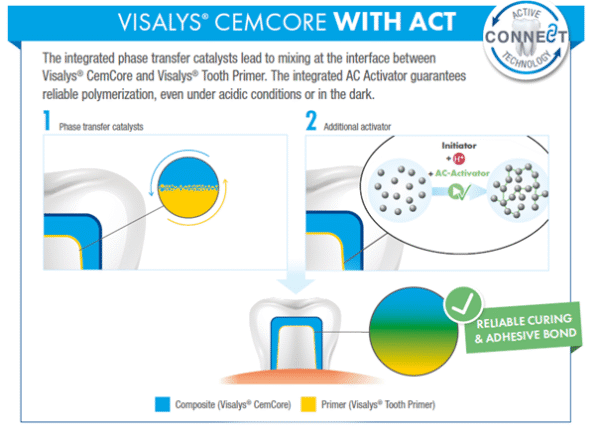
Dual-curing composites without Active Connect Technology often do not cure completely on acid-etched tooth surfaces and/or those pretreated with adhesive or primer and require an additional activator (referred to as self-cure activators (SCA)).
Cementation composites must be as hydrophilic as possible while also having very good flowability. Core build-ups require a high degree of stability and a material that swells as little as possible. Kettenbach Dental has developed a groundbreaking technology that simply eliminates the conflicts: Active-Connect-Technology (ACT) allows optimal mixing of the somewhat hydrophobic cementation composite Visalys® CemCore with the hydrophilic Visalys® Tooth Primer on the damp surface of the tooth. The innovative composite achieves a high adhesive strength despite its hydrophobic properties while also avoiding swelling.
After the contact of Visalys® CemCore (hydrophobic) with the water-based VISALYS® Tooth Primer (hydrophilic), which penetrates deep into the tooth surface, the phase transfer catalyst is activated:
Yes. Visalys® CemCore is also suitable for attachment to common implant abutments. The abutment must be pre-treated according to the specifications of the respective manufacturer.
Unlike universal bondings, the Visalys® Restorative Primer is not acidic, leading to the adhesive monomers in the primer being particularly stable.
Yes. The Visalys® Restorative Primer is ideal for the pre-treatment of fracture surfaces.
A water-based primer ensures a well-opened collagen network even in the event of accidental overdrying of the dentin and penetrates deep into the surface. Since no organic solvent such as ethanol is used, optimal wetting of the hydrophilic dentine surface can be guaranteed. In addition, water cannot evaporate from the opened bottle as quickly as organic solvents.
The Visalys® Tooth Primer can also be used as an adhesive/primer with Visalys® Core. Use with other composites is not indicated.
No. Although the use of a restoration primer is mandatory, other restoration primers suitable for the respective surface can also be used.
Yes. The excellent adhesion values to the tooth substance can only be achieved by combining Visalys® CemCore and Visalys® Tooth Primer.
The values, however, are significantly poorer than the combination of Visalys® Restorative Primer and Visalys® CemCore.
Bonding test (ISO 29022)
Visalys® Tooth Primer applied to the surface for 20 seconds (see below), then air-dried, followed by curing of Visalys® CemCore without a polymerisation lamp.
Results (averages of 10 specimens):
Metal 1 (titanium): 10.5 MPa
Metal 2 (non-precious metal, NPM): 12.0 MPa
Oxide ceramic (zirconium dioxide, ZrO2): 7.3 MPa
Glass ceramic (lithium disilicate): 5.8 MPa
Summary:
The combination of Visalys® Tooth Primer and Visalys® CemCore achieves sufficient bonding strength on all surfaces (≥ 5 MPa for this setup).
On glass ceramics, adhesion is only minimally above the threshold value of 5 MPa, as without the silane contained in Visalys® Restorative Primer, proper bonding is not possible.
Recommendation:
The bonding values are sufficient, so the respective laboratory need not be concerned about debonding of the connections.
Nevertheless, this combination is contraindicated and is not mentioned in the instructions for use.
In future, choose the correct material combination (Visalys® Tooth Primer for tooth substrate only, Visalys® Restorative Primer for restorative materials).
It is important to determine whether the bonding failed on the tooth side (with residual composite cement on the resin-bonded bridge) or on the restoration side (with residual composite cement on the tooth surface).
Resin-bonded bridges can be somewhat challenging, as they require high bond strength while at the same time offering only a limited surface for adhesion. In this specific case, we recommend selectively etching the enamel surface (see the information in the instructions for use).
For the resin-bonded bridge itself, we recommend following the established procedures, depending on the material from which the bridge is made:
In both cases, Visalys® Restorative Primer is then applied as usual.
The pretreatment of the restoration surface / resin-bonded bridge is very important, as increasing the surface area (through sandblasting or hydrofluoric acid etching) is the key factor for successful bonding.
Before cementation with Visalys® CemCore, Visalys® Tooth Primer is first applied to the tooth surface.
Resin-bonded bridges can be somewhat challenging, as they require high bond strength while at the same time offering only a limited surface for adhesion. In this specific case, we recommend selectively etching the enamel surface (see the information in the instructions for use).
For the resin-bonded bridge itself, we recommend following the established procedures, depending on the material from which the bridge is made:
In both cases, Visalys® Restorative Primer is then applied as usual.
The pretreatment of the restoration surface / resin-bonded bridge is very important, as increasing the surface area (through sandblasting or hydrofluoric acid etching) is the key factor for successful bonding.
Before cementation with Visalys® CemCore, Visalys® Tooth Primer is first applied to the tooth surface.
Visalys® CemCore is the best choice for preventing tooth fractures for several reasons: Thanks to its extremely low water absorption properties, the risk of tooth fracture is reduced. Visalys® CemCore is a 2-in-1 dual-curing luting composite and core build-up material. It offers excellent dimensional stability and, with its unique Active-Connect Technology, guarantees optimal adhesive bond for all indirect restorations. With Visalys® CemCore, you really are on the safe side: The material is also 100% free from bisphenol A.
Visalys® CemCore from Kettenbach Dental is a dual-curing luting composite designed for safe and predictable cementation of all indirect restorations. This 2-in-1 product can also be used for fabricating core build-ups and build-up fillings. The unique, patented Active-Connect Technology eliminates typical conflicts and enables optimal mixing of the somewhat hydrophobic composite Visalys® CemCore with the hydrophilic Visalys® Tooth Primer on the damp tooth surface, resulting in a permanently high adhesive bond. Visalys® CemCore features excellent flow properties, is radiopaque, bisphenol-A-free, and ready to use.
Yes. A mixing tips’s diameter and length must be matched to the material. Some mixers available on the market appear to be suitable, but do not mix homogeneously. To ensure best results, always use original Kettenbach Dental mixing tips. The right accessories are shown for each product on our website.
Do not use latex gloves. Latex has a negative effect on the curing of A-silicones and Identium® and can cause poor-quality impressions.
First bring the impression materials to room temperature (processing and curing times are affected by higher or lower temperatures). Do not use latex gloves or a polyether “contaminated” impression syringe. First remove the inhibition layer (lubricating layer) from an individual tray before taking an impression. When using a hand mix A-silicone Lab putty, always use the same ratio of catalyst and base material. To ensure best results, always use original Kettenbach Dental mixing tips.
Temperature (warmer or colder than room temperature), latex and a polyether “contaminated” impression syringe, but also the inhibition layer (lubricating layer) of a temporary restoration material that has remained on the preparation. Furthermore, some retraction agents may have a negative effect on curing; we have not received any complaints about this with regard to Kettenbach impression materials for decades. With a hand-mixed A-silicone putty, it is important that the ratio of catalyst to base material is 50/50% – if this is not the case, not only will the times mentioned change, but also the technical properties of the putty impression material. To ensure best results, always use original Kettenbach Dental mixing tips.
When selecting a ready-made tray, it is important to choose a well-fitting, rigid tray and customise it if desired. To create sufficient pressure with medium (Type 2) and heavy body (Type 1) impression material, choose a closed impression tray. By choosing a full impression tray instead of a partial tray, the laboratory obtains the desired dental information.
We recommend always using a custom tray when taking impressions with impression posts. Prefabricated trays can also be customized by damming around the palate area or on the end of the tray for a greater build-up of pressure. It must always be considered with the size that the distance between the tray wall and the tooth equator is at least 3 times greater than the depth of the undercut.
Impression material shrinks (minimally) and in order to make this shrinkage predictable and controllable, it is important to be able to create an even impression material thickness between the elements and the inside of the impression tray. Because adhesion occurs between the tray and the impression material, this material shrinkage always occurs towards the tray wall. The more shrinkage the impression material has, the greater the cement thickness will be when placing the crown and bridge work. An individual tray for a dentate situation must have sufficient impression material space (at least 4 to 5 mm).
It is important to note that a good individual tray can only be made thanks to a correct preliminary impression with alginate or Silginat® (scan-optimised A-silicone impression material). If trays are to be printed, it is preferable to make the preliminary impression with a scan-optimised impression material. For crown and bridge work, it is important that the tray is not too tight; in addition to blocking out undercuts, sufficient impression space (at least 4 to 5 mm) must also be created. Any inhibition layer on the plastic individual tray can interfere with the curing process of the impression material and must be thoroughly removed before use. After checking the fit, use the appropriate tray adhesive (also just over the edges). An adhesive only has a good adhesive effect once the adhesive layer is dry (after approximately 4 minutes).
General guidance: always follow the manufacturer’s instructions and the product IFU, and observe working and setting times. For more tips, consult our full troubleshooting guide.
Consider external factors that could affect the processing and curing of the impression material: These include temperature (warmer or colder than room temperature), use of latex gloves, a polyether “contaminated” impression syringe, and the inhibition layer (lubricant layer) of temporary restoration material left on the preparation. Furthermore, some retraction agents may have a negative effect on the curing of the impression material; we have not received any complaints about this with regard to Kettenbach impression materials for decades. For sufficient pressure with a medium and heavy body consistency, preferably use a closed impression tray. Ensure that it is coated with the correct tray adhesive; the adhesive must be dry before the tray is filled with impression material. With a customized impression tray, ensure sufficient space (4 to 5 mm) and remove any inhibition layer. Important: remove retraction cord or paste and any cotton rolls from the patient’s mouth just before taking the impression.
Begin the best preparation for printing by first determining the tray selection and individualising it if necessary. Coat the trays with adhesive before preparation; also just over the edges (adhesive must be dry for the adhesive effect). Prepare a partial tray so that, if desired, a second impression can be made immediately after removal. Due to the pressure during the first impression, there is a good chance that any bleeding will be under control. Prepare the mixing gun/syringe/device for use and set the timer to the desired total curing time. The practitioner and assistant should be ready to start spraying the preparation and filling the impression tray simultaneously.
Important: remove retraction cord or paste and any cotton rolls from the patient’s mouth just before taking the impression.
Impression material should be stored in a dry place at room temperature. Direct sunlight and extreme temperature changes must be avoided. If storage temperature is clearly below/above room temperature, bring the impression material to room temperature before use. If the impression material is too cold during impression taking, the setting times will be longer than stated, and if you are working in a (too) warm room, the processing and setting times will be much faster than normal. Always follow the manufacturer’s advices in the IFU.
Before taking an impression, any bleeding must be brought under control. Some retraction agents can have a negative effect on the curing process of the impression material; we have not received any complaints about this with regard to Kettenbach impression materials for decades. Remove retraction cord or paste and any cotton rolls from the patient’s mouth just before inserting the tray into the patient’s mouth.
There are plenty of impression materials available that can be used to achieve the desired transfer of the oral situation to the working model. The best choice is to use an impression technique, with the corresponding consistency(ies), that suits the practitioner and the requirements of the dental laboratory. The success of the final piece of work is partly determined by the ease of use, the material properties and knowledge of the impression material.
Identium® is a highly accurate impression material with excellent pressure build-up, high tensile strength and tear resistance, easier to remove from the mouth and a more pleasant taste. Thanks to its unique composition, Identium® has the best properties of both polyether and addition silicones; the best of both worlds. Thanks to their high final hardness (immediately after removal from the mouth), Identium® Medium and Heavy (including the fast variants) are highly suitable as impression materials for all your implant work. If an impression combination with Identium® light is made, it is important that the transfer pins are sufficiently enclosed by the stronger Identium® Medium or Heavy impression material.
Yes. A mixing tips’s diameter and length must be matched to the material. Some mixers available on the market appear to be suitable, but do not mix homogeneously. To ensure best results, always use original Kettenbach Dental mixing tips. The right accessories are shown for each product on our website.
Do not use latex gloves. Latex has a negative effect on the curing of A-silicones and Identium® and can cause poor-quality impressions.
When selecting a ready-made tray, it is important to choose a well-fitting, rigid tray and customise it if desired. To create sufficient pressure with medium (Type 2) and heavy body (Type 1) impression material, choose a closed impression tray. By choosing a full impression tray instead of a partial tray, the laboratory obtains the desired dental information.
We recommend always using a custom tray when taking impressions with impression posts. Prefabricated trays can also be customized by damming around the palate area or on the end of the tray for a greater build-up of pressure. It must always be considered with the size that the distance between the tray wall and the tooth equator is at least 3 times greater than the depth of the undercut.
Impression material shrinks (minimally) and in order to make this shrinkage predictable and controllable, it is important to be able to create an even impression material thickness between the elements and the inside of the impression tray. Because adhesion occurs between the tray and the impression material, this material shrinkage always occurs towards the tray wall. The more shrinkage the impression material has, the greater the cement thickness will be when placing the crown and bridge work. An individual tray for a dentate situation must have sufficient impression material space (at least 4 to 5 mm).
It is important to note that a good individual tray can only be made thanks to a correct preliminary impression with alginate or Silginat® (scan-optimised A-silicone impression material). If trays are to be printed, it is preferable to make the preliminary impression with a scan-optimised impression material. For crown and bridge work, it is important that the tray is not too tight; in addition to blocking out undercuts, sufficient impression space (at least 4 to 5 mm) must also be created. Any inhibition layer on the plastic individual tray can interfere with the curing process of the impression material and must be thoroughly removed before use. After checking the fit, use the appropriate tray adhesive (also just over the edges). An adhesive only has a good adhesive effect once the adhesive layer is dry (after approximately 4 minutes).
General guidance: always follow the manufacturer’s instructions and the product IFU, and observe working and setting times. For more tips, consult our full troubleshooting guide.
Consider external factors that could affect the processing and curing of the impression material: These include temperature (warmer or colder than room temperature), use of latex gloves, a polyether “contaminated” impression syringe, and the inhibition layer (lubricant layer) of temporary restoration material left on the preparation. Furthermore, some retraction agents may have a negative effect on the curing of the impression material; we have not received any complaints about this with regard to Kettenbach impression materials for decades. For sufficient pressure with a medium and heavy body consistency, preferably use a closed impression tray. Ensure that it is coated with the correct tray adhesive; the adhesive must be dry before the tray is filled with impression material. With a customized impression tray, ensure sufficient space (4 to 5 mm) and remove any inhibition layer. Important: remove retraction cord or paste and any cotton rolls from the patient’s mouth just before taking the impression.
Begin the best preparation for printing by first determining the tray selection and individualising it if necessary. Coat the trays with adhesive before preparation; also just over the edges (adhesive must be dry for the adhesive effect). Prepare a partial tray so that, if desired, a second impression can be made immediately after removal. Due to the pressure during the first impression, there is a good chance that any bleeding will be under control. Prepare the mixing gun/syringe/device for use and set the timer to the desired total curing time. The practitioner and assistant should be ready to start spraying the preparation and filling the impression tray simultaneously.
Important: remove retraction cord or paste and any cotton rolls from the patient’s mouth just before taking the impression.
Impression material should be stored in a dry place at room temperature. Direct sunlight and extreme temperature changes must be avoided. If storage temperature is clearly below/above room temperature, bring the impression material to room temperature before use. If the impression material is too cold during impression taking, the setting times will be longer than stated, and if you are working in a (too) warm room, the processing and setting times will be much faster than normal. Always follow the manufacturer’s advices in the IFU.
Before taking an impression, any bleeding must be brought under control. Some retraction agents can have a negative effect on the curing process of the impression material; we have not received any complaints about this with regard to Kettenbach impression materials for decades. Remove retraction cord or paste and any cotton rolls from the patient’s mouth just before inserting the tray into the patient’s mouth.
Before processing Identium® impression material, first bring the impression material to room temperature. Processing and curing times are affected by higher or lower temperatures. Do not use latex gloves or a polyether “contaminated” impression syringes. First remove the inhibition layer (lubricant layer) from an individual tray before taking an impression.
Temperature (warmer or colder than room temperature), latex and a polyether “contaminated” impression syringe, as well as the inhibition layer (lubricating layer) of a temporary restoration material left behind on the preparation, can adversely affect the curing of the Identium® impression material. Furthermore, some retraction agents may have a negative effect on curing; however, we have not received any complaints about this in relation to Kettenbach impression materials for decades.
Mucopren® soft from Kettenbach Dental is a rebasing material based on addition silicone for direct and indirect application. A durable, reliable, soft-staying and comfortable soft liner that lasts longer than just a few months. An amazing end result with a guaranteed wear time of at least one year. Also very suitable as a bridge (old prosthesis) to relieve the operative part (implants) during the healing period.